
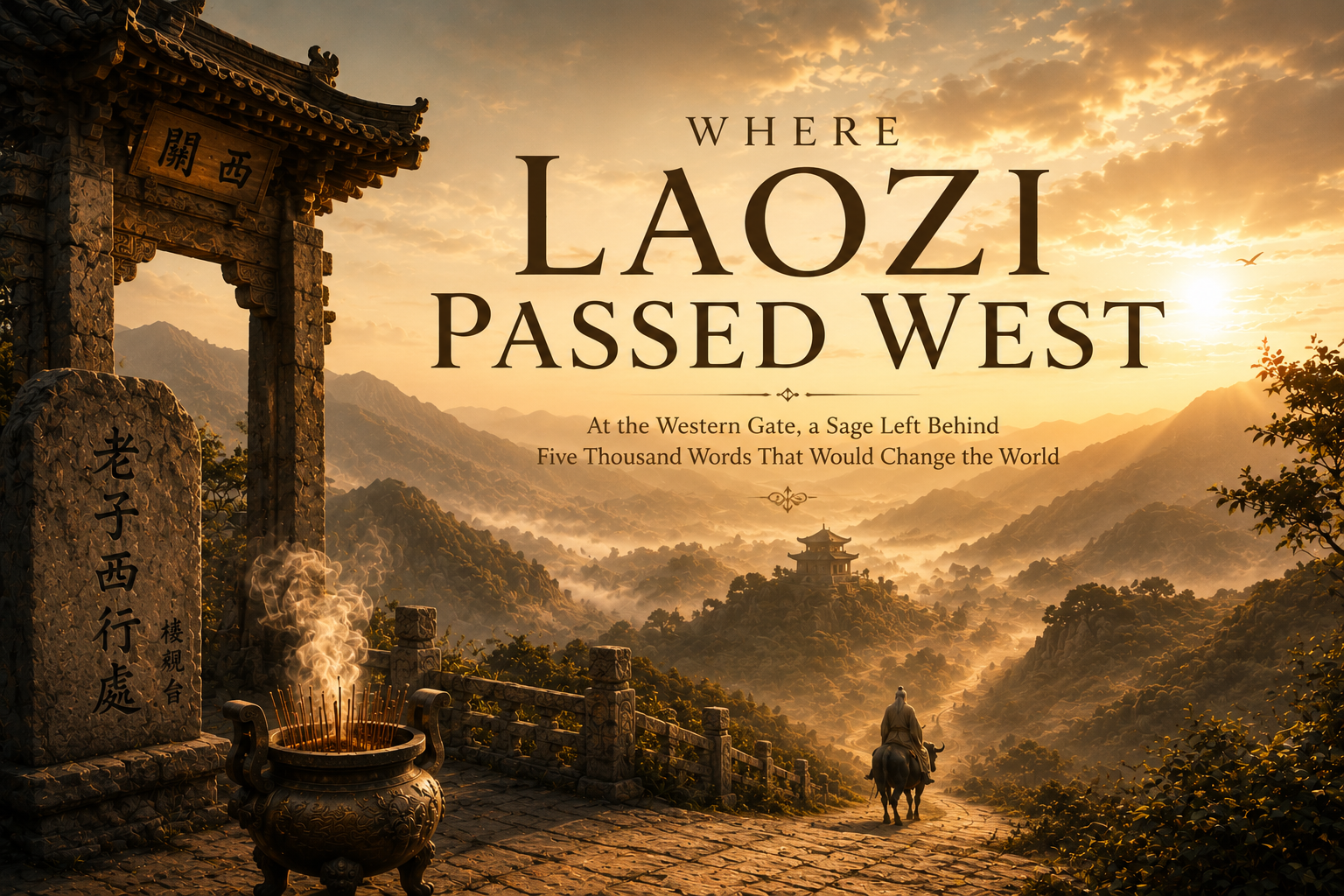
Who We AreWhere Laozi Passed West
The Journey That Changed Chinese Thought
At the western edge of the ancient Zhou world, where the great plains of China rise toward the rugged Qinling Mountains, a quiet story has echoed for more than two thousand years.
It is the story of departure.
According to tradition, an aging scholar named Laozi looked upon a world falling into disorder and chose to leave it behind. He did not gather followers. He did not seek power. He did not establish a school. Instead, he mounted a water buffalo and rode westward toward the mountains.
What happened next would become one of the most enduring legends in Chinese civilization.
Today that story is remembered at Louguan Tai, a sacred site nestled among the foothills of Shaanxi's Qinling Mountains. Though modest in scale compared to the soaring peaks of Wudang or the ancient forests of Qingcheng, Louguan Tai occupies a unique place in Taoist memory. It is here, according to tradition, that Laozi left behind the words that would become the Tao Te Ching.
Leaving the World Behind
The China of Laozi's time was changing.
The authority of the Zhou kings had weakened, regional states competed for influence, and social order seemed increasingly uncertain. Philosophers and scholars searched for answers. Some advocated strict laws and stronger government. Others sought moral reform.
Laozi chose a different path.
Rather than trying to reshape society, he turned away from it.
The legend tells of a man who had spent years studying the patterns of nature, observing the rise and fall of rulers, and contemplating the deeper currents beneath human affairs. As disorder spread across the land, he concluded that wisdom could not be imposed upon the world.
So he departed.
The image of Laozi riding westward became one of the most powerful symbols in Taoist culture. It represents a return to simplicity, a withdrawal from ambition, and a search for harmony beyond the noise of political life.
The Gatekeeper's Request
As Laozi approached the western frontier, he arrived at a mountain pass guarded by a man named Yin Xi.
Unlike the officials and rulers Laozi left behind, Yin Xi is remembered as someone who recognized wisdom when he saw it.
Sensing the significance of the traveler before him, the gatekeeper asked a simple request:
Before you leave, record your teachings.
Laozi agreed.
At the pass, surrounded by mountains and overlooking the boundary between civilization and wilderness, he composed a short text of approximately five thousand Chinese characters.
That text became the Tao Te Ching.
Its eighty-one brief chapters speak of humility, balance, leadership, simplicity, and the mysterious source from which all things emerge. The work would influence philosophers, poets, artists, rulers, monks, and ordinary people for centuries.
Yet its origins remain inseparable from this moment of departure.
The Tao Te Ching was not written in a royal court or a great academy. It was written at the edge of the known world by a man preparing to disappear.
"A good traveler has no fixed plans and is not intent upon arriving."
— Tao Te Ching, Chapter 27
Into the Mountains
The story does not end with the manuscript.
After completing the text, Laozi continued westward.
Some legends claim he entered the mountains and lived as a hermit. Others suggest he journeyed beyond China entirely. Still others portray him as transcending ordinary human existence and becoming an immortal sage.
No one knows what became of him.
That uncertainty is part of the story's power.
Unlike many religious founders whose lives are carefully documented, Laozi vanishes into mystery. His disappearance mirrors one of the central themes of the Tao Te Ching itself: the greatest truths often remain hidden, and the deepest wisdom leaves no trace.
Louguan Tai Today
Over the centuries temples, pavilions, and monasteries arose around the place where Laozi was believed to have written his teachings.
The name Louguan Tai—"Lookout Tower Platform"—recalls the observation tower that once stood near the pass. Pilgrims, scholars, and seekers traveled here to honor both the sage and the text he left behind.
Today visitors encounter quiet courtyards, stone pathways, incense-filled halls, and inscriptions carved with passages from the Tao Te Ching. The surrounding foothills of the Qinling Mountains provide a landscape that feels removed from the rush of modern life.
The atmosphere encourages reflection.
This is not merely a place associated with a historical figure. It is a place associated with a moment—a turning point when one man's departure became the beginning of a philosophical tradition that would endure for millennia.
The Meaning of the Western Journey
The story of Laozi passing west survives because it speaks to something universal.
Every generation encounters moments when certainty fades and familiar structures begin to feel unstable. The legend suggests that wisdom is not always found through control, achievement, or struggle. Sometimes it emerges through simplicity, observation, and a willingness to follow a quieter path.
At Louguan Tai, the journey of Laozi remains unfinished.
The sage still rides westward through the imagination of countless readers. The gatekeeper still asks his question. The Tao Te Ching still waits to be opened.
And the mountains still stand where legend says the old master disappeared beyond the horizon, leaving behind a few thousand words that continue to guide seekers around the world.