
The Living Heart of Taoism
The History and Significance of Taoist Temples
Sacred Spaces of the Tao
Across the mountains, forests, and ancient cities of China stand thousands of Taoist temples—quiet sanctuaries where philosophy, ritual, and daily life meet. For centuries these temples have served as places of worship, learning, and spiritual cultivation, shaping the development of Taoism as both a philosophy and a living religious tradition.
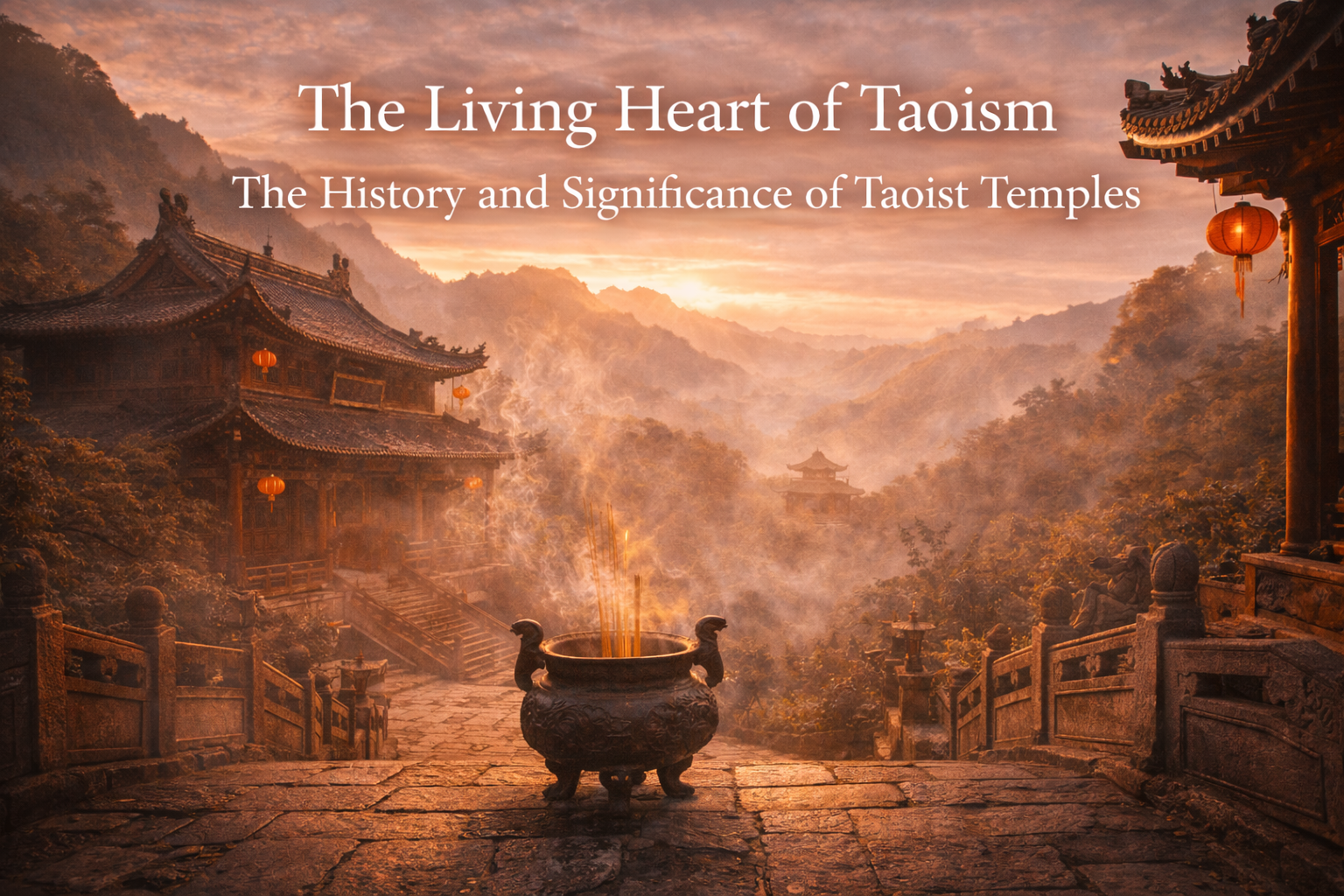
Within their courtyards, incense smoke rises slowly toward the sky while monks chant ancient scriptures and visitors offer prayers. These temples are more than architectural landmarks; they are centers where Taoist teachings are practiced, preserved, and passed from generation to generation.
The Origins of Taoist Temples
Taoism emerged as an organized religious tradition during the late Han dynasty (around the 2nd century CE), when philosophical teachings associated with Laozi and the Tao Te Ching began to develop institutional structures and priesthoods.
As Taoism evolved into a religious tradition, temples were built to serve as ritual centers for priests and followers, dedicated to Taoist deities, immortals, and the pursuit of spiritual cultivation.
These early temples—often called guan or gong—became places where priests conducted ceremonies, studied sacred texts, and guided communities in spiritual practice.
Over time, Taoist temples spread throughout China and beyond, forming networks of monasteries, pilgrimage sites, and community shrines.
Temples and the Natural World
One of the most distinctive features of Taoist temples is their relationship with the landscape. Unlike many urban religious buildings, Taoist temples were often constructed in mountains, forests, or remote valleys where practitioners could cultivate quiet contemplation and harmony with nature.
Mountains in particular held deep spiritual significance. Taoists believed that high peaks were places where heaven and earth met, allowing spiritual energy—known as qi—to circulate freely through the landscape.
Temples built in these environments became centers for meditation, internal cultivation practices, and the development of Taoist philosophy.
Famous examples include:
Mount Qingcheng temples in Sichuan
The Wudang Mountain temple complexes
White Cloud Temple in Beijing
The Eastern Peak Temple dedicated to Mount Tai
Each of these sacred locations helped shape the history and practice of Taoism.
Centers of Ritual and Worship
Taoist temples also serve as places where practitioners engage in ritual practices designed to maintain harmony between humans, nature, and the cosmos.
Temple rituals often include:
Burning incense and offerings
Chanting sacred scriptures
Ceremonial music and prayer
Festivals honoring deities and ancestors
These ceremonies are intended to align the practitioner with the natural flow of the Tao and restore balance between the human world and the spiritual realm.
At the heart of temple worship stands the altar, where statues or symbols of Taoist deities are honored through offerings of incense, fruit, tea, and candles.
Through ritual participation, Taoists express gratitude, seek guidance, and reaffirm their connection to the natural order.
Places of Learning and Transmission
Beyond ritual, Taoist temples have historically functioned as centers of education and spiritual training.
Monks and priests study classical texts such as:
Tao Te Ching
Zhuangzi
Taoist alchemical writings
Ritual manuals and scriptures
In temple communities, teachers pass on knowledge of meditation, breathing techniques, martial arts, healing traditions, and internal cultivation practices.
These teachings form the foundation of many disciplines now widely practiced around the world, including:
Tai Chi
Qigong
Taoist meditation
Internal alchemy (Neidan)
Through temples, these practices have been preserved and transmitted for centuries.
Temples and Community Life
Taoist temples are not only monastic retreats—they also serve as cultural and social centers for local communities.
Throughout the year temples host:
Seasonal festivals
Public ceremonies
Cultural celebrations
Pilgrimages and community gatherings
During these events, entire communities gather in temple courtyards to celebrate traditions that have been passed down for generations.
Temple rituals often emphasize collective harmony, reflecting the Taoist belief that human life is interconnected with nature and society.
Survival Through History
Despite their deep historical roots, Taoist temples have faced many challenges throughout history.
During the Cultural Revolution in the 20th century, many temples were destroyed or abandoned and religious practices were suppressed.
In recent decades, however, many temples have been restored and Taoist traditions have experienced a revival. Today they continue to serve as places where ancient teachings remain alive in the modern world.
The Living Tradition
Today Taoist temples can be found not only across China but throughout the world, serving communities in Taiwan, Southeast Asia, North America, and beyond.
These temples continue to fulfill the same roles they have for centuries:
places of worship
centers of learning
sites of pilgrimage
guardians of Taoist culture
Within their quiet courtyards and mountain landscapes, the teachings of the Tao are still practiced every day.
A Gateway to the Tao
For many practitioners, the temple is the starting point of the Taoist journey.
Here visitors encounter ancient teachings not as abstract philosophy, but as living traditions expressed through ritual, meditation, movement, and community life.
In this way, Taoist temples remain what they have always been—sacred gateways where the wisdom of the Tao continues to unfold across generations.