
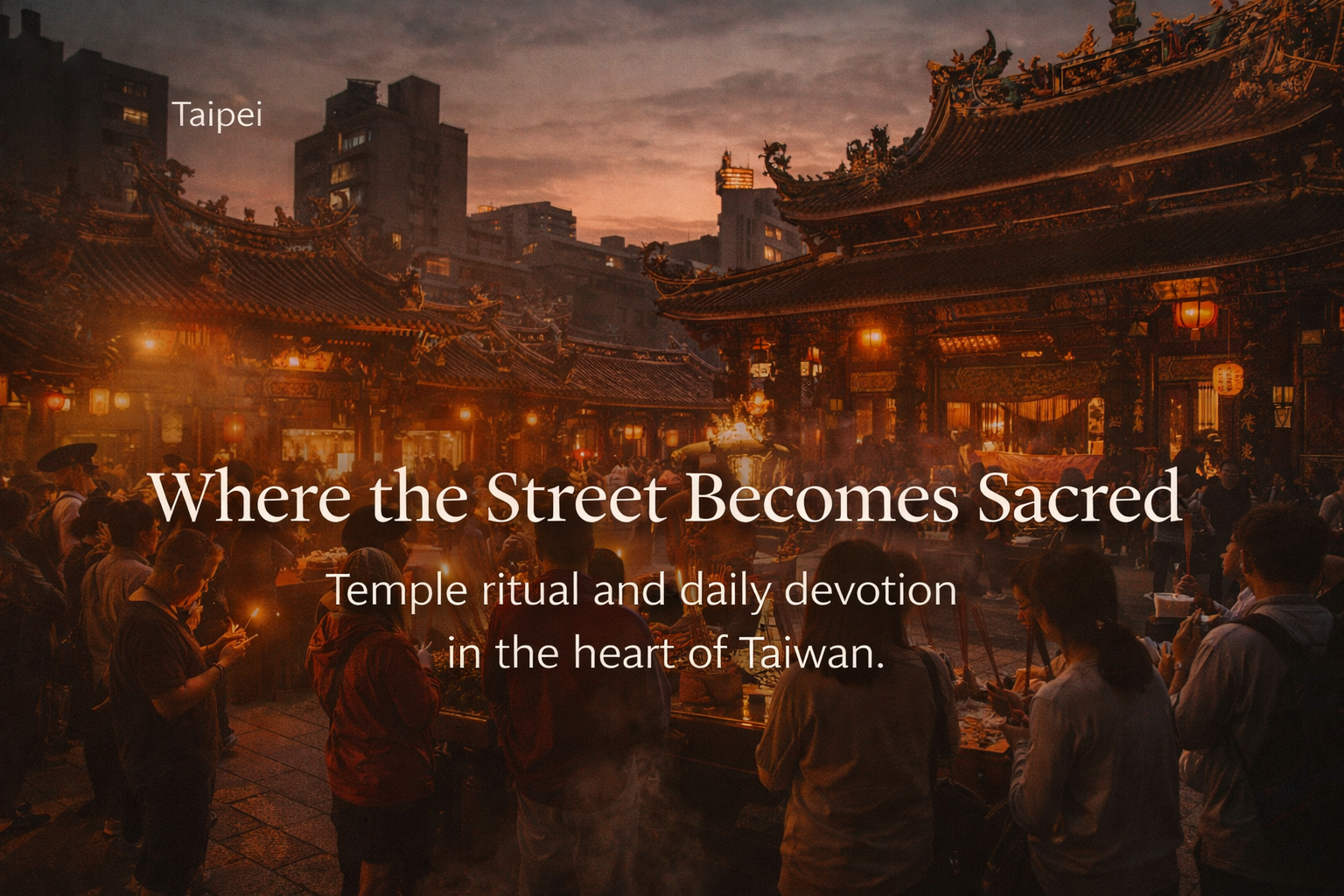
Taipei, Taiwan
Where the Street Becomes Sacred
Taoist Ritual in Everyday Life
In Taipei, Taoism does not hide in mountain sanctuaries or institutional halls. It lives in the open air—beneath lantern light, inside crowded temple courtyards, along sidewalks thick with incense smoke. Here, ritual is not distant or ceremonial in tone; it is participatory, immediate, and woven into the rhythm of daily life.
From the historic halls of Longshan Temple to the incense-filled arcades of Xingtian Temple, Taipei offers one of the most visible and communal expressions of Taoist practice anywhere in the world

A City of Temples
Taipei’s temple culture reflects centuries of migration and settlement. As waves of settlers from Fujian and Guangdong arrived, they brought deities, ritual systems, and architectural styles with them. Temples became more than religious sites—they were community centers, arbitration halls, cultural anchors, and social safety nets.
Longshan Temple, founded in the 18th century, remains one of the city’s most revered spiritual landmarks. Its carved beams, coiling incense spirals, and layered altars reveal a synthesis of Taoist, Buddhist, and folk religious traditions. Devotees move deliberately from altar to altar, offering incense, bowing in sequence, and consulting divination blocks.
This ritual choreography is not theatrical—it is habitual, practiced, learned from family, and passed down across generations.
Ritual as Public Life
In Taipei, ritual does not stay within temple walls.
During major festivals—Lunar New Year, the Ghost Festival, deity birthdays—entire neighborhoods transform. Temporary altars appear outside storefronts. Red lanterns stretch across narrow streets. Processions move slowly through districts, accompanied by drums, banners, and community groups.
These events are not performances for tourists; they are acts of collective continuity. Families participate together. Volunteers organize offerings. Children observe and learn.
The city itself becomes sacred space.
“In Taipei, ritual spills into the street, and the street becomes sacred.”
Healing Traditions and Spirit Consultation
Taipei’s temple culture is inseparable from its healing traditions.
Visitors to Xingtian Temple often come not only to pray, but to seek guidance. Divination practices—casting jiaobei moon blocks or drawing numbered oracle sticks—remain common. Temple volunteers interpret signs. Devotees request clarity on family matters, business decisions, health concerns.
Traditional Chinese medicine clinics are widespread throughout the city, many informed by Taoist cosmology. Herbal prescriptions, acupuncture, and dietary adjustments are framed within the balance of yin and yang and the movement of qi.
In Taipei, healing is not compartmentalized—it is spiritual, physical, and communal at once.
Martial Arts and Embodied Philosophy
The Taoist body is cultivated as much as the temple is maintained.
At dawn, parks across Taipei fill with practitioners of taijiquan and qigong. Movements unfold slowly, synchronized with breath and internal focus. These are not spectacles; they are daily disciplines.
Martial arts schools preserve lineages connected to internal styles shaped by Taoist philosophy. Balance, softness, redirection of force—these principles mirror cosmological ideas found in Taoist texts.
Here, philosophy is not abstract. It is practiced.
Preservation Through Participation
Taiwan’s religious openness has allowed Taoist traditions to flourish publicly and adapt organically. Rather than becoming museum artifacts, temple rituals evolve while retaining their structure. Younger generations participate in festivals, volunteer at temples, and continue family traditions of devotion.
Taipei shows how Taoism can remain both ancient and contemporary—unchanged in principle, yet responsive in form.
It is not a relic here.
It is lived.