

The Taoist Calendar
Sacred Days Across the Lunar Year
In Taoism, time is not simply measured—it is honored.
The year unfolds according to lunar cycles, seasonal transitions, celestial alignments, and the birth anniversaries of revered deities. Unlike the fixed rhythm of the Gregorian calendar, the Taoist calendar moves with the moon. Its festivals are not static holidays; they are moments of realignment—between heaven and earth, spirit and body, past and present.
Across cities like Beijing, Taipei, and Singapore, these sacred days remain visible. They reshape neighborhoods, awaken temples, and draw communities into shared ritual life.

Lunar New Year
Renewal and Realignment
The Taoist New Year is not merely celebratory—it is cosmological. Homes are cleaned to clear stagnant qi. Offerings are made to kitchen gods and ancestors. Temple courtyards glow with incense and red lantern light.
In Taipei, entire districts transform into corridors of devotion. In Beijing, temple fairs revive historic ritual traditions. In Singapore, community altars appear in housing estates, reaffirming continuity across generations.
This is the reset of the year—not through resolution, but through reverence.
The Lantern Festival
Illumination and Harmony
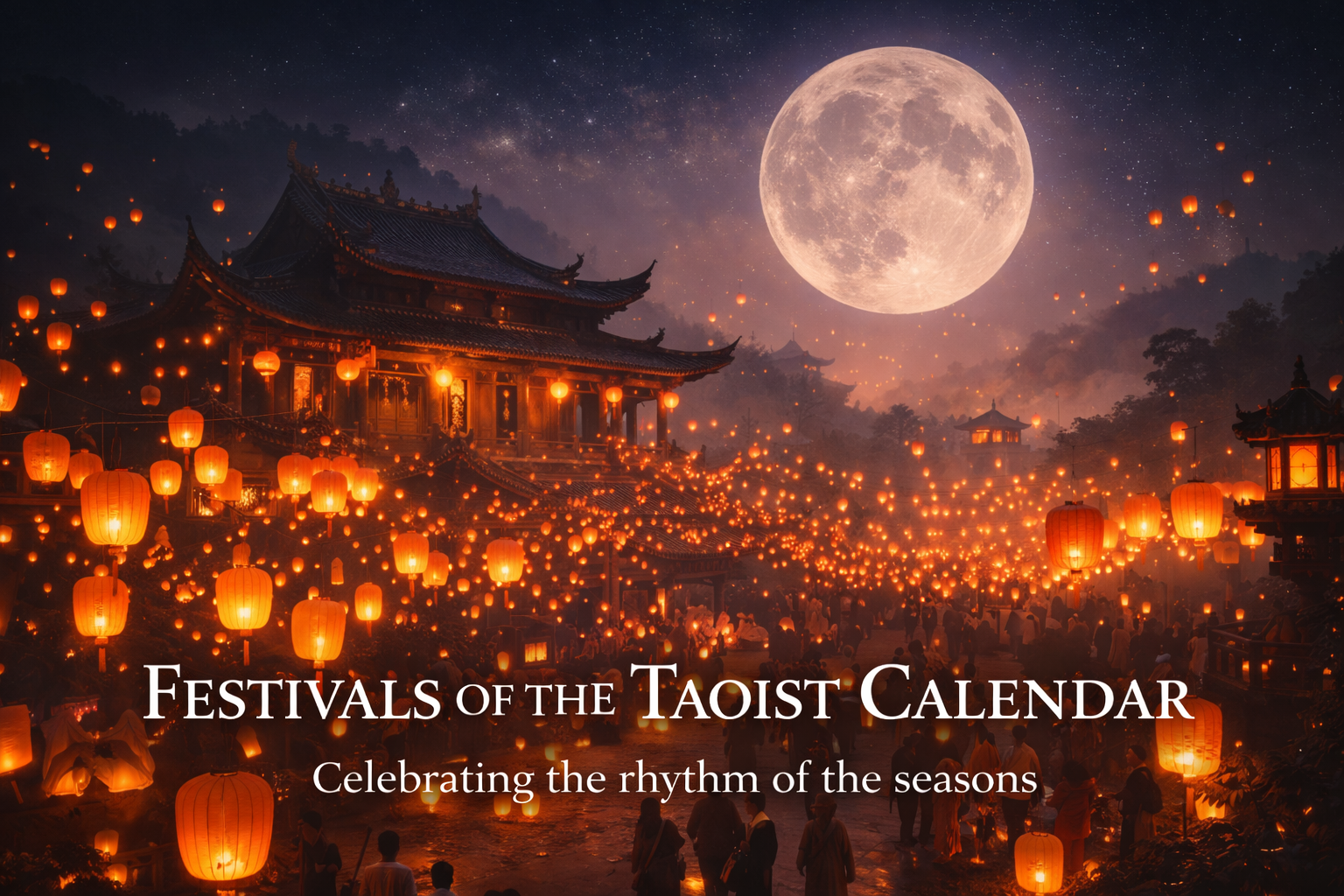
Fifteen days after the New Year, lanterns fill the sky and streets. Symbolizing illumination and reunion, the Lantern Festival closes the New Year cycle.
Temples host ceremonies that emphasize unity—between family members, between community groups, and between the earthly and celestial realms. In Taiwan especially, lantern displays become massive communal expressions of identity.
Light becomes a metaphor for clarity and balanced intention.
The Birthday of the Jade Emperor
Celestial Order
The Jade Emperor, regarded as a supreme celestial ruler in Taoist cosmology, is honored on the ninth day of the first lunar month.
Devotees gather in temples before dawn, offering incense and symbolic gifts. The ritual affirms cosmic structure—the belief that heaven, earth, and humanity exist within a balanced hierarchy.
In urban settings, this observance reinforces continuity between ancient mythic frameworks and modern civic life.
The Dragon Boat Festival
Protection and Purification
Though often associated with cultural legend, the Dragon Boat Festival carries Taoist undercurrents of purification and protection.
Herbs are hung at doorways. Protective charms are worn. The season’s shift into summer heat marks a time when illness and imbalance are believed to increase. Ritual and remedy intersect here.
In Singapore and Taipei alike, the festival blends communal celebration with subtle cosmological awareness.
The Hungry Ghost Festival
Ancestral Reverence and Compassion
Perhaps the most visually dramatic of Taoist observances, the Hungry Ghost Festival unfolds during the seventh lunar month.
Temporary altars appear in streets and courtyards. Offerings are laid out for wandering spirits. Opera stages are constructed outdoors. Entire communities participate in ritual acts of remembrance and appeasement.
In Singapore, this festival is particularly visible—incense smoke drifting upward beneath high-rise apartments.
It is not fear that drives the ritual, but responsibility—to ancestors, to unseen presences, to cosmic balance.
The Double Ninth Festival
Longevity and Reflection
Observed in autumn, the Double Ninth Festival emphasizes longevity, elder reverence, and contemplation.
Climbing hills or visiting elevated spaces symbolizes aspiration and renewal. Chrysanthemum wine and seasonal foods reflect the Taoist alignment between diet and seasonal energy.
In cities, the symbolism shifts slightly—but the principle remains: honor time, honor elders, honor continuity.


“The Taoist calendar does not mark time—it harmonizes it.”
Why Festivals Matter in Urban Taoism
Festivals serve as public theology. They:
• Reinforce shared identity
• Connect families to lineage
• Align communities with seasonal shifts
• Translate abstract philosophy into lived experience
In Beijing, Taipei, and Singapore, these observances transform modern streets into ritual space.
They remind the city that not all time is transactional. Some time is sacred.