
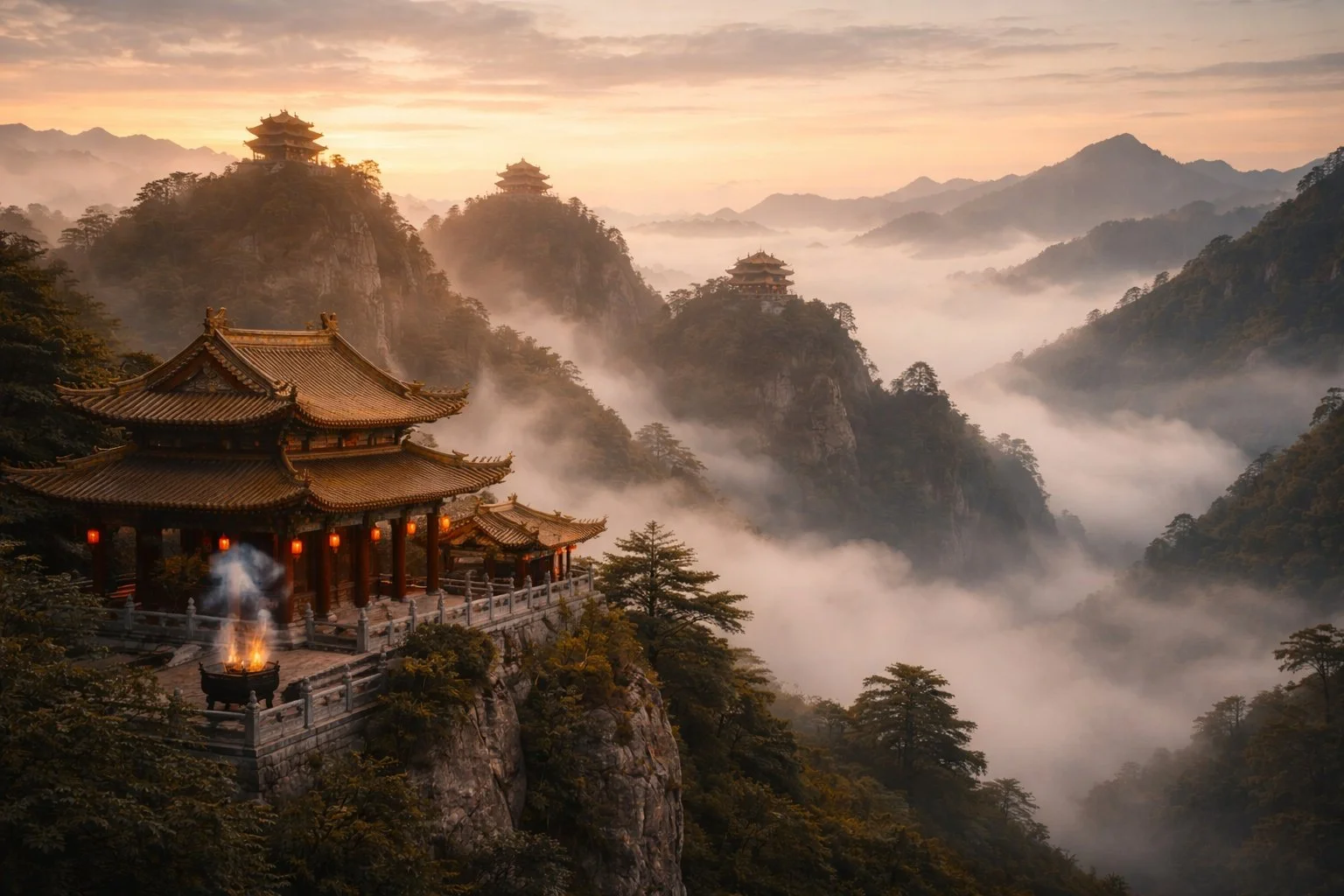
Ten Sacred Taoist Mountains and Temples

1. Wudang Mountains (China)
One of the most revered centers of Taoism in China, the Wudang Mountains are known for their dramatic temple complexes built along steep mountain ridges. The site has long been associated with spiritual cultivation, meditation, and internal martial arts traditions.

2. Qingcheng Mountain (China)
Considered the birthplace of organized Taoism, Qingcheng Mountain is associated with the early teachings of Zhang Daoling, founder of the Celestial Masters tradition.
Meet Your Instructors

3. Longhu Mountain (China)
Longhu Mountain, known as “Dragon Tiger Mountain,” is the ancestral seat of the Celestial Masters lineage and has been a major Taoist pilgrimage site for centuries.

4. Baiyun Temple (Beijing)
One of the most important Taoist monasteries in northern China, Baiyun Temple serves as a center for the Quanzhen tradition and remains an active religious institution today.

5. Louguan Tai (China)
Traditionally believed to be the place where Laozi composed or transmitted the Tao Te Ching before departing toward the west.
6. Maoshan (China)
Maoshan is a sacred mountain associated with the Shangqing school of Taoism and known historically for meditation caves and alchemical practices.
Meet Your Instructors
7. Laojun Mountain (China)
Named after Laozi (Laojun), this dramatic mountain temple complex rises above the clouds and has become one of China’s most visually iconic Taoist sites.
8. Heming Mountain (China)
Often associated with the early development of Taoist religious organization and the Celestial Masters movement.
9. Taiyi Mountain Temples
Linked to the worship of the Taiyi deity and ancient cosmological traditions.
10. Thian Hock Keng (Singapore)
One of the most important Chinese temples in Southeast Asia, built by early Chinese immigrants to honor the sea goddess Mazu and maintain Taoist ritual life abroad.