

Singapore
Incense Beneath Glass Towers
Taoist Tradition in a Global City
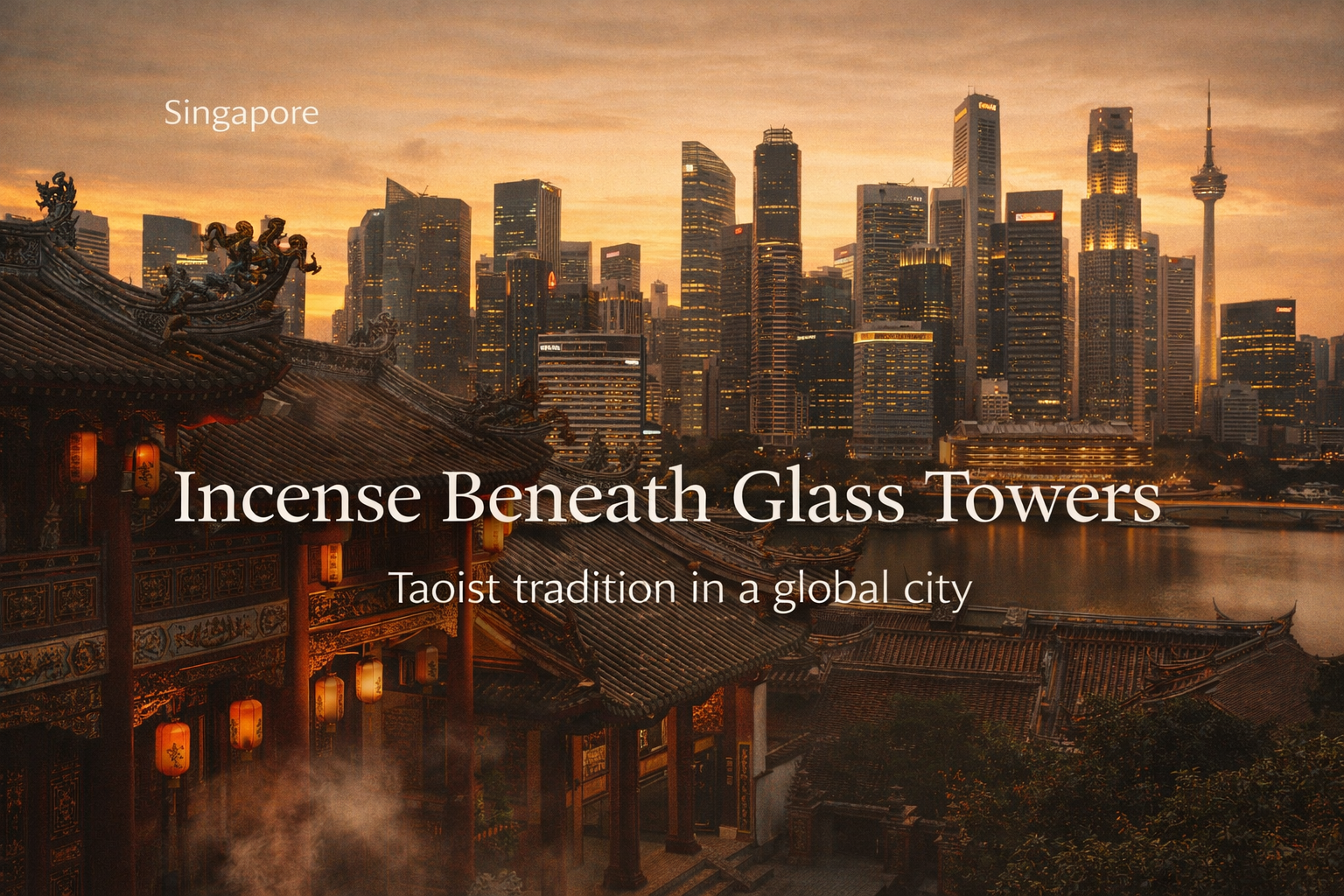
As the sun sets over Marina Bay, the skyline of Singapore glows with glass and steel. Financial institutions, technology firms, and multinational headquarters dominate the horizon. Yet only a short walk from these towers stands Thian Hock Keng Temple—its carved beams, incense coils, and red lanterns quietly anchoring a spiritual tradition that predates the city’s modern identity.
Singapore presents one of the most compelling examples of Taoism’s adaptability. Here, ancient ritual systems do not retreat from modernity—they coexist with it.
A Temple Built by Immigrants
Our Story
Thian Hock Keng, constructed in the 19th century by Hokkien immigrants, was originally a place of gratitude. Seafarers who survived perilous journeys across the South China Sea would visit to offer thanks to Mazu, the sea goddess, and to seek protection for future voyages. The temple functioned not only as a religious site but as a social and communal anchor for new arrivals.
As Singapore developed into a global trading hub, and later a modern financial center, the temple remained. Urban renewal transformed the surrounding districts, but its carved timber structures, ceramic figurines, and granite columns endured.
Today, the temple stands as both heritage landmark and active ritual space—its architecture preserved even as skyscrapers rise behind it.

Community Rituals in a Vertical City
Taoism in Singapore is most visible during festival seasons.
The Hungry Ghost Festival, held during the seventh lunar month, transforms neighborhoods across the island. Temporary altars appear in housing estates and along sidewalks. Offerings of fruit, rice, incense, and paper goods are laid out to honor wandering spirits. Traditional Chinese opera performances are staged in open spaces, often with front rows intentionally left empty—for unseen guests.
In a city known for efficiency and order, these rituals introduce a different rhythm—one tied to lunar cycles, ancestral remembrance, and cosmological balance.
Community participation remains strong. Families attend together. Volunteers organize events. Ritual specialists conduct ceremonies that have changed little in form over generations.
Singapore demonstrates that ritual life can thrive even in highly regulated urban environments.
Healing Traditions and Energetic Balance
Beyond temple festivals, Taoist influence permeates Singapore’s healing landscape.
Traditional Chinese medicine clinics are widespread, and many continue to draw upon Taoist energetic principles: the balance of yin and yang, the five elements, and the movement of qi through meridians. Herbal remedies, acupuncture, and dietary therapy are integrated into contemporary healthcare choices.
For many Singaporeans, these practices are not seen as alternative—they are complementary. Modern hospitals and ancient cosmology coexist within daily life.
The Taoist view of health as balance rather than symptom management remains quietly influential.
Martial Arts and Urban Cultivation
Early mornings across Singapore reveal another layer of Taoist practice.
In parks and community spaces, practitioners gather for taijiquan and qigong. Slow, deliberate movements unfold against a backdrop of high-rise apartments. Breath synchronizes with motion; stillness emerges amid city noise.
Martial arts schools throughout the island continue to teach internal disciplines rooted in Taoist philosophy. Though some schools emphasize sport, others preserve the contemplative dimension—movement as meditation, discipline as moral cultivation.
In this way, the Taoist body becomes a bridge between ancient training methods and contemporary urban life.
Adaptation Without Erasure
Singapore’s development has been rapid and relentless. Entire districts have transformed within decades. Yet Taoist temples remain integrated into the national heritage framework, protected and maintained as part of the city’s cultural identity.
Rather than resisting modernization, Taoist communities have adapted. Ritual schedules adjust to urban work patterns. Festivals operate within regulatory guidelines. Temples engage younger generations through educational programs and cultural outreach.
This is not preservation through isolation—it is preservation through evolution.
“In Singapore, incense rises beneath glass towers — ancient rhythm within a modern skyline.”
The Living Tao in Singapore
Taoism in Singapore is neither hidden nor dominant. It is interwoven.
It appears in temple courtyards and housing estates, in herbal clinics and martial arts studios, in festival nights and quiet morning practice. It exists as heritage and as lived experience.
In a city defined by progress, Taoism offers continuity—reminding its practitioners that balance, reverence, and harmony are not relics of the past, but disciplines for the present.