❋
October 3-7 | Starting at $500The Reset Retreat: Yucca Valley
Taoist Temples in the Modern World
Ancient Traditions in a Changing Era
Preserving an Ancient Tradition
Despite centuries of political and cultural change, Taoist temples continue to serve as centers of spiritual practice and cultural preservation.
Many temples that were damaged or abandoned during the twentieth century have been restored in recent decades. These restorations reflect renewed interest in traditional Chinese culture and spiritual heritage.
Today temples function not only as religious spaces but also as historical landmarks and cultural institutions.
Temples as Cultural Centers
Modern Taoist temples often host a variety of activities that connect traditional teachings with contemporary communities.
Visitors may encounter:
meditation classes
martial arts training
cultural festivals
calligraphy and music instruction
These programs allow people from many backgrounds to explore Taoist philosophy and practice.
Pilgrimage and Tourism
Sacred mountain temples remain important destinations for pilgrims seeking spiritual inspiration. At the same time, many temples also welcome travelers interested in learning about Taoist history and culture.
Sites such as Mount Wudang, Mount Qingcheng, and White Cloud Temple attract visitors from around the world who come to experience the beauty and tranquility of these historic places.
Taoism in the Global Age
As Taoist teachings spread internationally, temples have also appeared outside of China. Communities in Taiwan, Southeast Asia, Europe, and North America now maintain Taoist temples where rituals, festivals, and educational programs continue.
These global communities demonstrate how Taoist traditions have adapted to new environments while preserving the core values of harmony, balance, and connection with nature.
A Living Tradition
Though the world around them has changed dramatically, Taoist temples remain places where ancient wisdom continues to guide modern life.
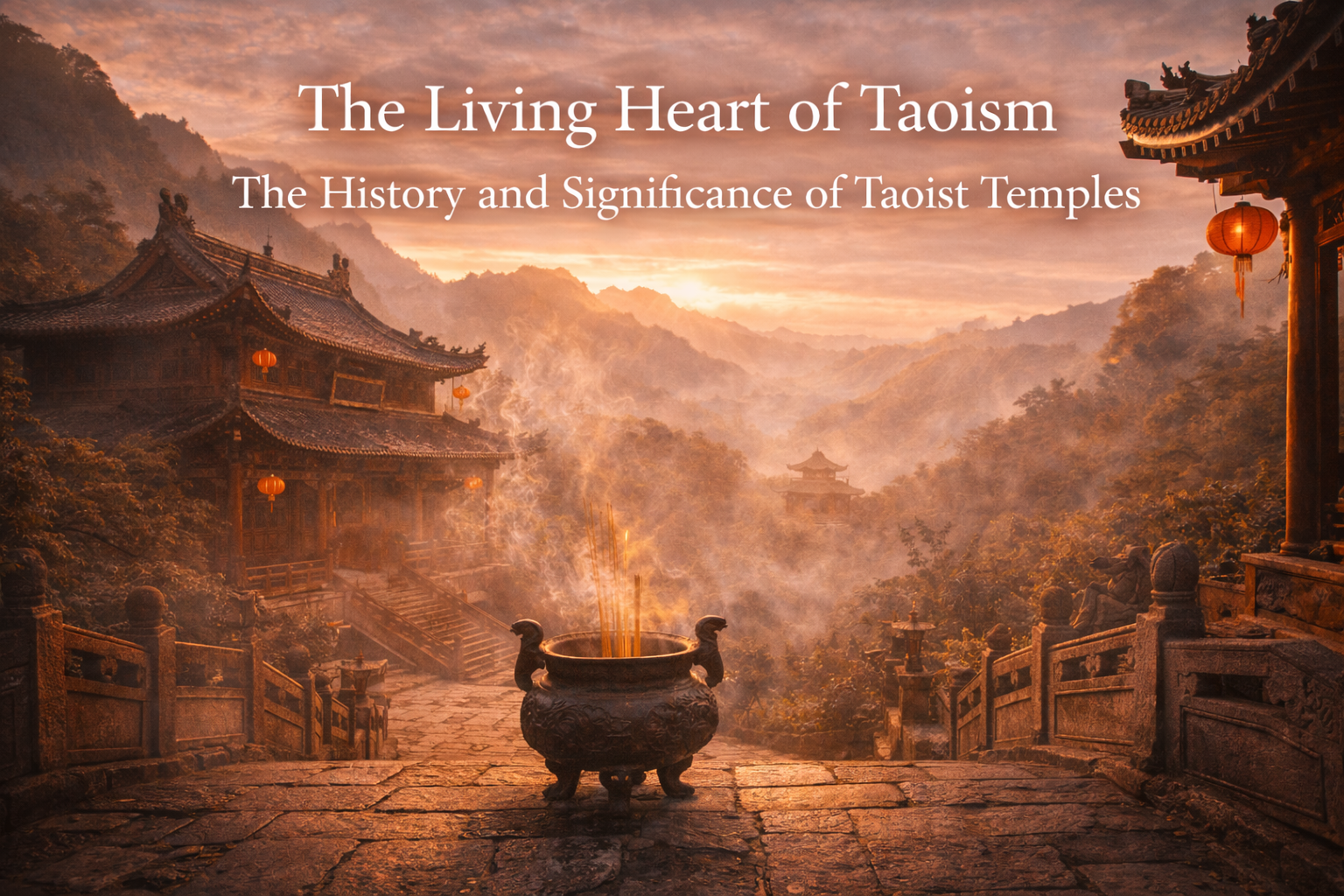
Within temple courtyards, incense still rises toward the sky, bells still echo through mountain valleys, and practitioners continue to study the teachings that have shaped Taoism for centuries.
In this way, Taoist temples stand not only as historical monuments but as living reminders that the path of the Tao is still unfolding.
❋
October 3-7 | Starting at $500The Reset Retreat: Yucca Valley
Taoist Temples in the Modern World
Ancient Traditions in a Changing Era
Preserving an Ancient Tradition
Despite centuries of political and cultural change, Taoist temples continue to serve as centers of spiritual practice and cultural preservation.
Many temples that were damaged or abandoned during the twentieth century have been restored in recent decades. These restorations reflect renewed interest in traditional Chinese culture and spiritual heritage.
Today temples function not only as religious spaces but also as historical landmarks and cultural institutions.
Temples as Cultural Centers
Modern Taoist temples often host a variety of activities that connect traditional teachings with contemporary communities.
Visitors may encounter:
meditation classes
martial arts training
cultural festivals
calligraphy and music instruction
These programs allow people from many backgrounds to explore Taoist philosophy and practice.
Pilgrimage and Tourism
Sacred mountain temples remain important destinations for pilgrims seeking spiritual inspiration. At the same time, many temples also welcome travelers interested in learning about Taoist history and culture.
Sites such as Mount Wudang, Mount Qingcheng, and White Cloud Temple attract visitors from around the world who come to experience the beauty and tranquility of these historic places.
Taoism in the Global Age
As Taoist teachings spread internationally, temples have also appeared outside of China. Communities in Taiwan, Southeast Asia, Europe, and North America now maintain Taoist temples where rituals, festivals, and educational programs continue.
These global communities demonstrate how Taoist traditions have adapted to new environments while preserving the core values of harmony, balance, and connection with nature.
A Living Tradition
Though the world around them has changed dramatically, Taoist temples remain places where ancient wisdom continues to guide modern life.
Within temple courtyards, incense still rises toward the sky, bells still echo through mountain valleys, and practitioners continue to study the teachings that have shaped Taoism for centuries.
In this way, Taoist temples stand not only as historical monuments but as living reminders that the path of the Tao is still unfolding.
Temples as Gateways to the Tao
Where Philosophy Becomes Experience
The Threshold Between Worlds
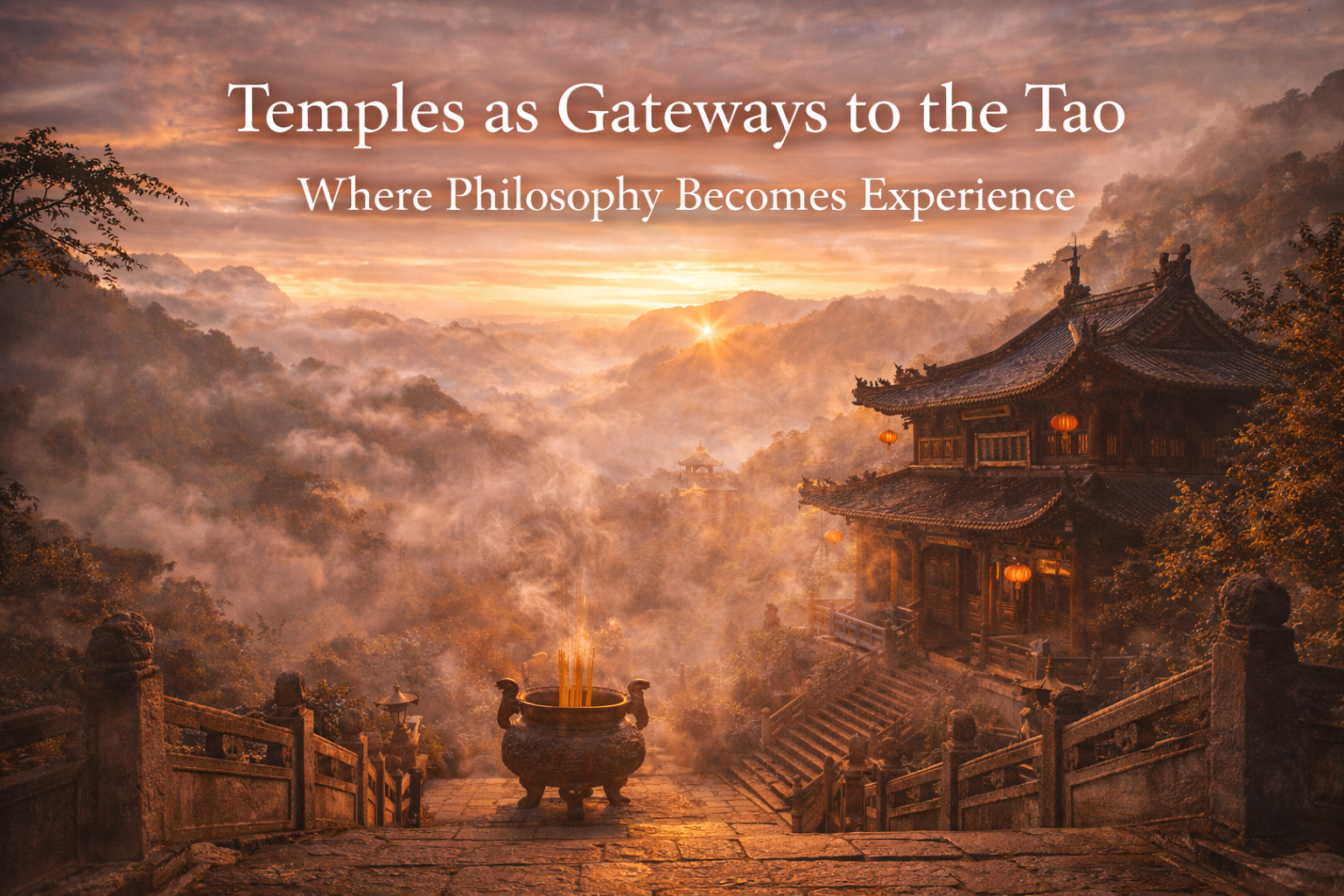
For centuries, Taoist temples have served as gateways between the everyday world and the deeper mysteries of the Tao. Within their quiet courtyards and mountain halls, philosophy becomes something that can be experienced through ritual, meditation, and reflection.
Visitors who enter these sacred spaces often encounter more than architecture or tradition. The scent of incense, the sound of temple bells, and the stillness of the surrounding landscape create an atmosphere that encourages contemplation and inner balance.
In this way, the temple becomes a place where individuals can pause, step away from the distractions of daily life, and reconnect with the natural rhythm of existence.
A Place of Learning and Transformation
Throughout Taoist history, temples have been places where wisdom is not only studied but practiced. Teachers guide students in meditation, breathing techniques, and spiritual cultivation, while communities gather to celebrate festivals and rituals that preserve ancient traditions.
The teachings of the Tao are therefore transmitted not only through written texts but through living practice. Each ceremony, meditation session, or quiet moment in a temple courtyard becomes part of a continuous tradition that stretches back thousands of years.
The Tao in Everyday Life
While temples provide sacred spaces for spiritual cultivation, the ultimate goal of Taoist practice is not to remain within temple walls. Instead, practitioners seek to carry the wisdom of the Tao into everyday life.
The lessons learned in temples — balance, simplicity, patience, and harmony with nature — guide how individuals move through the world beyond the temple gates.
In this sense, the temple is both a destination and a starting point: a place where seekers encounter the teachings of the Tao before bringing those insights back into their daily lives.
The Enduring Presence of the Tao
Across mountains, cities, and villages, Taoist temples continue to stand as quiet guardians of a tradition that has shaped philosophy, culture, and spiritual practice for centuries.
Their stone pathways and incense-filled halls remind visitors that the wisdom of the Tao is not confined to history or scripture. It remains present in the living world — in nature, in community, and within the quiet awareness of each individual.
For those who seek understanding, the temple doors remain open, inviting all who enter to experience the timeless flow of the Tao.